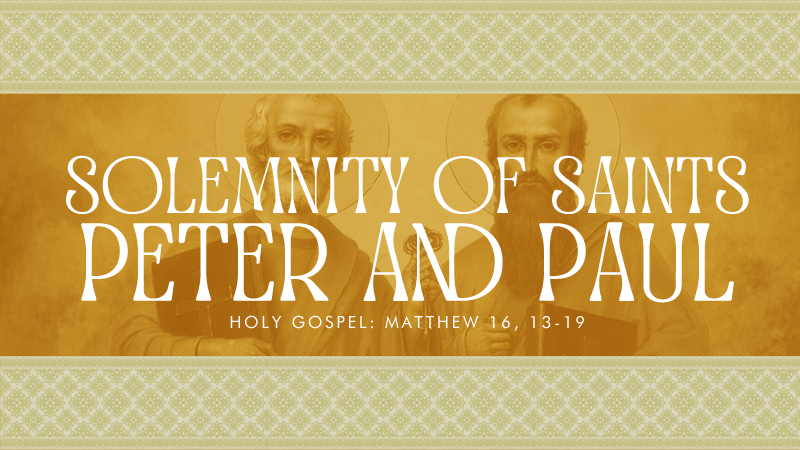


SUNDAY REFLECTIONS| Solemnity of Saints Peter and Paul, Apostles
By Social Communications
Published on June 29, 2025
“When Jesus went into the region of Caesarea Philippi He asked His disciples, ‘Who do people say that the Son of Man is?’ They replied, ‘Some say John the Baptist, others Elijah, still others Jeremiah or one of the prophets.’ He said to them, ‘But who do you say that I am?’ Simon Peter said in reply, ‘You are the Christ, the Son of the living God.’ Jesus said to him in reply, ‘Blessed are you, Simon son of Jonah. For flesh and blood has not revealed this to you, but my heavenly Father. And so I say to you, you are Peter, and upon this rock I will build my Church, and the gates of the netherworld shall not prevail against it.’”
(Matthew 16:13–18)
Today the Church celebrates the great solemnity of Saints Peter and Paul—two towering figures of faith who, though very different in personality and background, were united in their passionate love for Christ and their unwavering commitment to the mission of the Church.
The Gospel takes us to Caesarea Philippi, where Jesus poses a profound question to His disciples: “Who do people say that the Son of Man is?” It is a moment of reflection and revelation. The disciples offer various answers, echoing the public opinion of the time. But then Jesus turns the question to them directly: “But who do you say that I am?” This is the heart of discipleship—not what others say, but what we believe. It is the question Jesus asks each of us, again and again.
Simon Peter, moved by grace, responds with clarity and conviction: “You are the Christ, the Son of the living God.” This declaration is more than just correct theology; it is a profession of faith born from a deep personal relationship with Jesus. Peter speaks not just with his mind, but with his heart. And Jesus recognizes this moment as a divine revelation—“flesh and blood has not revealed this to you, but my heavenly Father.”
What follows is one of the most important statements in the New Testament: “You are Peter, and upon this rock I will build my Church.” Here, Jesus gives Simon a new identity, a new mission, and a foundational role in the life of the Church. Peter, the imperfect, impulsive fisherman, is chosen to be the rock upon which Christ will build His Church. It is a reminder that God calls and strengthens the weak, entrusting them with divine responsibilities. Peter’s strength will not come from his personality or achievements, but from his faith in Christ and the grace of God at work in him.
The Church that Jesus builds is not simply a human organization. It is a spiritual reality, formed by the will of Christ and sustained by the power of the Holy Spirit. The promise given to Peter—that the gates of the netherworld will not prevail against it—is a promise to all of us who belong to the Body of Christ. The Church will face trials, opposition, and even internal weakness, but it will never be overcome. Christ Himself is its foundation and its faithful shepherd.
Paul, though not mentioned in this particular Gospel, is inseparable from this feast. If Peter represents the solid foundation of unity and leadership, Paul represents the fire of missionary zeal. While Peter shepherded the early Christian community, Paul carried the Gospel to the nations. Though they had their differences, they were both led by the same Spirit and served the same Lord, ultimately giving their lives in witness to the truth.
This feast invites us not only to honor Peter and Paul, but to follow their example. Like Peter, we are called to confess Jesus as the Christ—not just with our lips, but with our lives. And like Paul, we are called to be bold witnesses, bringing the message of salvation to every corner of the world. Both apostles remind us that our faith is not a private possession but a gift meant to be shared, proclaimed, and lived courageously.
In our own time, when the Church faces new challenges and questions, we are invited to return to this foundational moment. Who do we say that Jesus is? And what does our answer look like in action? May we renew our love for Christ and our trust in His Church, built not on human perfection, but on divine grace and the faith of those who, like Peter and Paul, gave everything for the Gospel.